If you own a foldable phone, you know the frustration: you open an app on the big inner screen and it sits in the middle with thick black bars on the sides, or it forgets where you were the moment you unfold the phone. Unfite brings you the full details of Google’s answer to that problem — new Google Play rules that force apps to behave properly on foldables, or lose the right to publish updates.
Google announced the new Google Play foldable app requirements on 18 November 2026, in a post on the official Android Developers Blog. From April 2027, every app on Google Play will have to meet a minimum quality bar for foldable phones. Apps that fail the test will not be able to publish new versions or updates on the Play Store, and Google says they may also become harder to find in the store.
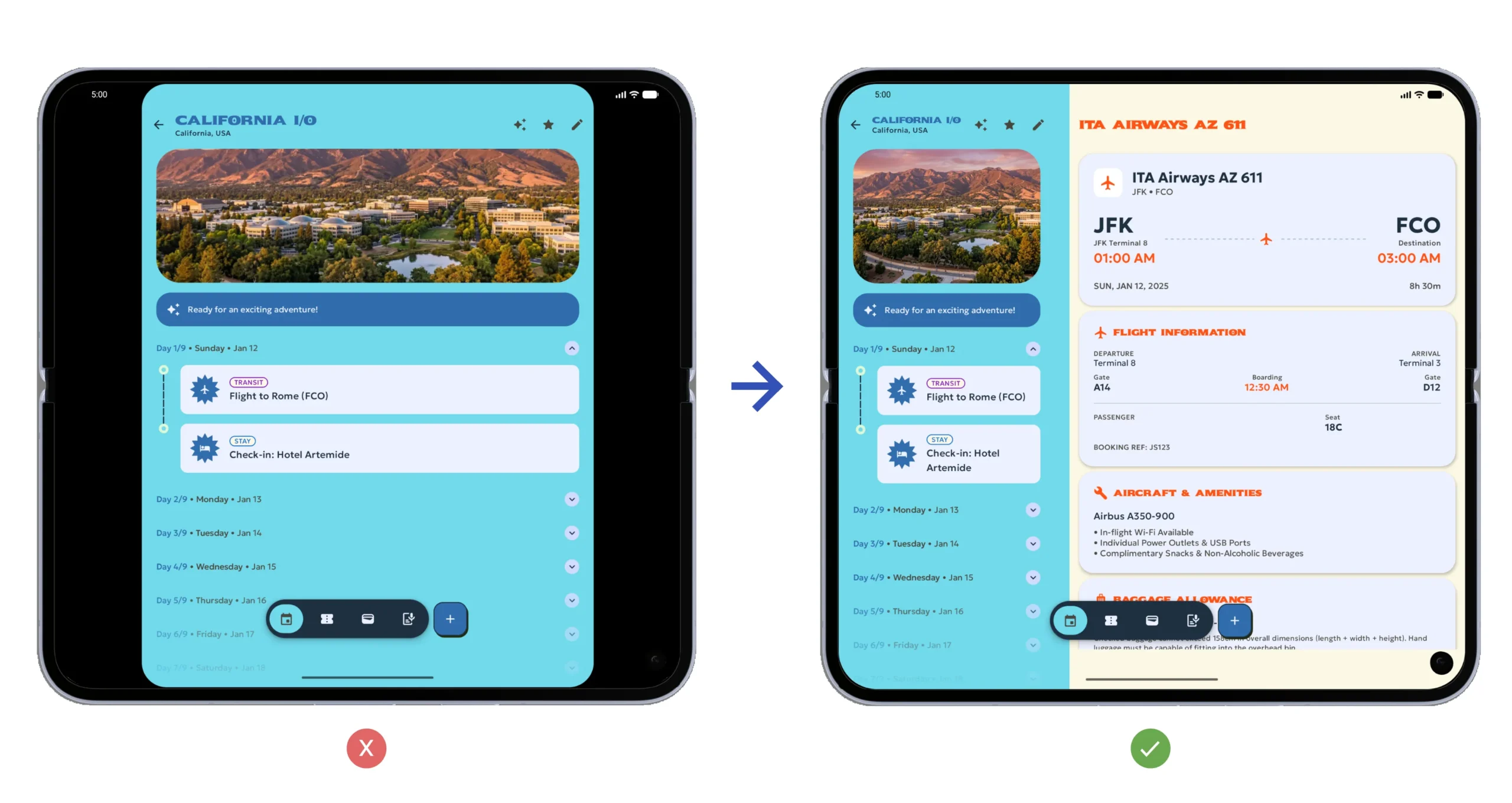
Google Play foldable app requirements: what apps must do now
The core of the new policy is a quality level Google calls Tier 3, or “Adaptive ready”. It is the lowest of three adaptive quality tiers, but from April 2027 it becomes the mandatory minimum for any app that wants to publish or update on Google Play. An app meets Tier 3 when it does four things on a foldable phone:
First, it must fill the whole display. No black bars, no letterboxing, and no compatibility mode that shrinks the app into a phone-sized box in the middle of a large screen. The app has to use all the space the unfolded display offers.
Second, it must keep your place. When you rotate the phone, fold it shut, unfold it, or resize the window, the app has to preserve your scroll position, any text you have typed, and media that is playing. A video should not restart and a half-written message should not disappear just because you opened the phone.
Third, it must support multi-window use, so it can run properly alongside another app on the big screen.
Fourth, it must handle the transition smoothly. Google’s own illustration for the announcement shows the difference clearly: a foldable running an app in a narrow letterboxed column is marked wrong, while the same phone showing a proper two-pane layout across the full inner screen is marked right.
The screenshot rule: 3 foldable screenshots become compulsory
Alongside the quality bar, Google is changing what developers must show on their Play Store listings. From April 2027, every app submission and update must include 3 foldable device screenshots in addition to the standard 2 phone screenshots. Developers can already upload foldable screenshots through Play Console today, and Google says these will start appearing in Play Store listings over the next few weeks.
The screenshots must cover three views: an unfolded inner screen with a 1:1 aspect ratio, an unfolded inner screen with a 4:3 aspect ratio plus a folded outer screen in portrait at 10:16, with an optional 16:10 landscape shot. Google names the Samsung Galaxy Z Fold8 Ultra and Google Pixel 11 Pro Fold as examples of 1:1 inner-display foldables, and the Galaxy Z Fold8 as an example of a 4:3 inner-display foldable. Developers can capture the screenshots from a real foldable or from the Android Emulator.
For ordinary users, this is a small but useful change. Before you install an app on a foldable, you will be able to see how it actually looks on a foldable screen, instead of guessing from phone screenshots.
The full timeline: what changes and when
Google has set out the new rules in three stages, so developers have about five months to get ready.
| Milestone | What happens |
|---|---|
| November 2026 (live now) | Developers can upload foldable screenshots in Play Console. Apps that meet the higher Tier 2 or Tier 1 standards can apply for Play badging and better placement in the store. |
| April 2027 | Tier 3 “Adaptive ready” becomes compulsory for apps. New apps and updates must include 3 foldable screenshots. Apps that miss the bar cannot publish or update, and may lose visibility. |
| August 2027 | New and updated apps must target API level 37, which is Android 17. This also removes the developer opt-outs that let apps lock their orientation and window size on large screens. Games get their own Tier 3 deadline in August 2027. |
One point Google states clearly: apps that are already on the Play Store and are never updated will stay available for download after April 2027. The rules block new releases and updates, they do not delete old apps from the store. So an app you already use will not vanish overnight — but if its developer never updates it to meet the standard, it will slowly fall behind and may become harder to discover.
What the higher tiers mean
Tier 3 is only the floor. Google’s quality framework has two higher levels, and apps that reach them can earn store badging, editorial spotlighting and better merchandising on Google Play.
Tier 2, called “Adaptive optimized”, looks at responsive multi-pane layouts that do not stretch interface elements out of shape, plus basic support for external keyboards, mice, trackpads and styluses on foldables, tablets and other large-screen devices.
Tier 1, called “Adaptive differentiated”, is the top level. It covers foldable-specific experiences such as tabletop and book postures, camera continuity when you fold or unfold during a video call or recording, interactive picture-in-picture, and multi-instance support for media, video, reading and multitasking apps.
Google says the framework will gradually expand so that Tier 2 and Tier 1 standards also apply across tablets, Googlebooks and Android XR devices. The message to developers is to build for the higher tiers now, rather than doing the minimum and having to rebuild later.
What this means for foldable owners in India
Foldable phones are no longer a niche experiment. Google says there are now over 580 million large-screen Android devices in use, and premium foldables such as Samsung’s Galaxy Z Fold 7 and the Google Pixel 11 Pro Fold are selling in India in serious numbers. Yet anyone who has used one knows that plenty of popular apps still treat the big inner screen like a stretched phone display, with wasted space and broken layouts.
These Google Play foldable app requirements should fix that, slowly but surely. From April 2027, any app that wants to ship an update will have to work properly when unfolded. That covers the apps you use every day — banking, shopping, messaging, video and reading apps — not just games. Games get a few extra months, with their Tier 3 deadline in August 2027, and they must also keep touch controls lined up correctly after a fold.
There is a catch worth knowing. Small developers with limited resources may struggle to meet the deadline, and some rarely-updated apps may simply stop receiving updates instead of rebuilding their layouts. Google’s answer is that the tools are already available — Jetpack Compose for adaptive layouts, the Android Emulator for testing foldable screens without owning one, and the Android CLI for capturing compliant screenshots. For users, the practical result should still be positive: the apps that keep updating will work better on foldables, and the Play Store listings will finally show you what an app looks like unfolded before you install it.
It is also worth noting what this is not. This is not a new Android version and not a change to your phone’s software. Your foldable does not need an update for these rules to matter, and no app will suddenly stop working in April 2027. The change happens on the developer side, and you will notice it gradually, as updated apps start filling the screen properly and showing foldable screenshots in their listings.
For more on Samsung’s foldables, see our earlier post on the Galaxy Z Fold 7 November update: https://unfite.co.in/galaxy-z-fold-7-flip-7-november-update/
Pros and cons for foldable users
Good news:
- Apps will finally use the full inner display instead of showing black bars.
- Your scroll position, typed text and video playback will survive folding and unfolding.
- Play Store listings will show real foldable screenshots before you install.
- Multi-window use should work better, since it is part of the minimum standard.
- The best apps can earn badging and better placement, so good foldable apps become easier to find.
Things to watch:
- Some small or rarely-updated apps may stop getting updates instead of rebuilding for foldables.
- The full benefit only arrives as developers update their apps, so the change will be gradual, not instant.
- Games have until August 2027, so gaming on foldables improves later than regular apps.
- Apps that are never updated stay downloadable, so old letterboxed apps will still be around for a while.
How to check whether an app is foldable-ready
You do not need to install anything or change any setting. Over the next few weeks, foldable screenshots will start appearing in Play Store listings. When you open an app’s listing on your foldable, look for the foldable screenshots section — if the app shows its unfolded layout, the developer has already done the work. After April 2027, every newly updated app will have to include them. Unfite recommends checking the foldable screenshots before installing a new app on your foldable.
On your own phone, you can test the apps you use most. Open an app, scroll halfway down a feed, start typing a message, then fold and unfold the phone. If the app keeps your place and fills the screen, it already meets the new standard. If it restarts, loses your text or shows black bars, that is exactly the problem Google’s April 2027 deadline is meant to fix — and the next update from that developer will have to address it.
Google Play foldable app requirements: frequently asked questions
When do the Google Play foldable app requirements start?
The Tier 3 quality bar and the foldable screenshot rule take effect in April 2027. Developers can already upload foldable screenshots from November 2026, and apps must target Android 17 (API level 37) from August 2027.
Will my apps stop working on my foldable in April 2027?
No. Apps that are already installed will keep working, and apps that are never updated will stay downloadable. The rules only stop developers from publishing new versions or updates unless the app meets the Tier 3 standard.
What is Tier 3 “Adaptive ready”?
It is the minimum adaptive quality level for foldables. The app must fill the whole display without black bars, keep your scroll position, typed text and media playback when you fold, unfold, rotate or resize, and support multi-window use.
How many foldable screenshots will apps need?
From April 2027, app listings will need 3 foldable screenshots in addition to the standard 2 phone screenshots: a 1:1 unfolded inner display, a 4:3 unfolded inner display, and a 10:16 folded outer screen in portrait.
Do the rules apply to games too?
Yes, but games get more time. The Tier 3 large-screen quality standard for games takes effect in August 2027, while the foldable screenshot requirement still applies from April 2027.
Unfite will keep tracking how these rules play out in practice — which popular apps update first, and whether foldable owners actually notice the difference. For now, the message from Google is clear: if an app wants to keep updating on the Play Store, it will have to respect the big screen. That is good news for everyone who paid flagship money for a foldable phone.
Image Credit: Google — Official illustration via the Android Developers Blog